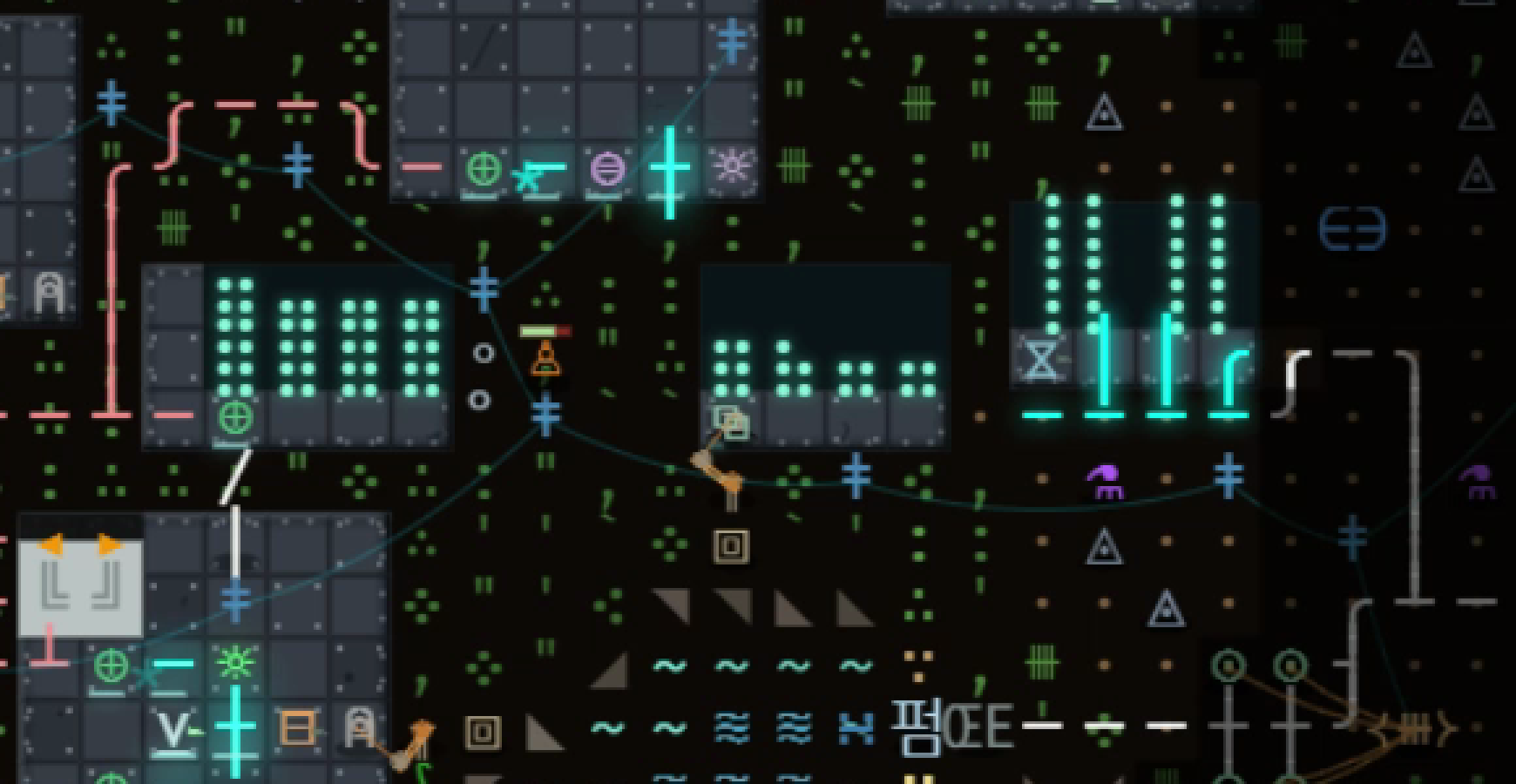
P.Logic is part of the paid Early Access progression. The free demo introduces the opening factory loop; it does not unlock the entire logic system.
What does programmable logic mean here?
In Textorio, you build the control circuit in the world. Components read a condition, transform a signal and drive an output. The resulting behaviour comes from the circuit you placed and connected. You do not need to open a general-purpose code editor to start experimenting.
Signals are represented as pressure values. That gives the system a physical character: the route and the component matter, as well as the decision you want to make. A pressure sensor and a machine control are different tools even when they sit beside the same production line.
This suits players who like automation as a design problem. If your favourite moment is replacing a repeated manual intervention with a rule, the control system offers another layer of factory building beyond adding more machines.
Read, decide, act
Read: a pressure sensor reports pressure from the adjacent system. Other components can read inventory or machine information. Choose a source that measures the thing you actually care about; a strong pressure reading is not proof that a storage chest contains enough items.
Decide: comparators, junction logic, memory, timers and counters let you turn a measurement into a condition. Some problems need a threshold. Others need a delay, a remembered state or a count of events. Start with the simplest rule that answers your question.
Act: components such as machine governors and pilot valves turn a signal into a change in the factory. Inspect the particular component's description and connections before routing the output. A signal line is useful only if it reaches something that can respond.
Design your first circuit on paper first
Write one sentence describing the behaviour you want. For example: “Reduce this machine's activity when the measured supply is low.” That is a design goal, not a ready-made layout: the correct components depend on which supply you are reading and what the destination supports.
- Pick one measurement. Inspect its live value before connecting a decision stage.
- Pick one rule. A single threshold is easier to diagnose than a chain of memory and timing components.
- Pick one output. Keep the controlled machine or valve close enough to inspect alongside the signal.
- Change the input deliberately. Confirm that the reading, decision and physical response each change as expected.
Press K and point at components to identify them. Use the wiki for component descriptions. If the underlying machine already lacks power or input material, fix that first; a logic circuit cannot manufacture the missing resource.
When simple thresholds are not enough
A control can chatter if a value repeatedly crosses one boundary. Memory lets a circuit keep a state instead of forgetting its last decision every moment. Timers and counters address different questions: how long a condition lasts, or how many events have happened.
The implemented P.Logic component set also includes differential, reservoir, selector, scaler and sequencer components. These extend the available signal processing, storage, selection and ordered behaviour. Treat them as tools to learn when a smaller circuit has already exposed a specific need.
Do not begin by building the most elaborate network possible. A circuit with one clear purpose is easier to test, move and expand. Keep a working small example so that a later failure can be compared with something you already understand.
Check the factory before blaming the logic
Trace the chain in order: source value, decision output, destination response. If the source is wrong, check what it is reading. If the decision is wrong, inspect thresholds and state. If the output is correct but the machine does nothing, inspect the machine's own requirements and the control connection.
Power, fluid supply and transport still exist underneath the controller. The power guide helps separate generation and distribution issues; the belt guide covers blocked material flow. This is why factory logic is interesting: the rule and the physical system have to agree.
Your next factory starts here
Try it. Build something of your own.
See how Textorio feels to play, then decide whether to make the full game your next factory.
The free demo and paid game are available from the Textorio Steam page.